Places of passion

August 25th, 2010

In the East Bay on a weekend, brewing beer in a backyard, the sky is blue. Next door the man keeps bees, and has a huge grill for turkey roasting.

“We’ll miss this yard, when we move,” the brewer tells me, checking the mash’s temperature. “We’ll have something, but nothing like this.”

The grass is a little downtrodden, but the space, filled by tables and chairs, dirt, a small tree, and the abandoned brickwork of a previous tenant’s patio improvement project, is a luxury. The constant cycle of movement, children to city, families to suburbs, is born of afternoons like this, sitting around in a yard with friends, brewing beer. In earlier stages of this churn we would examine each other’s TV’s, computers, liquor cabinets, bookshelves. We still do, for those items remain the touchstones of an apartment, easy ways to understand whose house we are in, what kind of person resides where we now stand.

The back yard survey though is new. Our initial duck indoors for introductions is perfunctory, and after a moment of silence is followed by our real purpose.

“So, do you want to see what I’ve been working on?”

Of course we do, and are soon standing in the sun discussing barley mills and temperatures, worts and the value of an art wholly encompassed by single syllable words. Brewing’s language is proof of its early invention, we surmise, back when simpler terms were still available for claiming, before our language had become stratified and new tasks had to be called time-sharing and bookkeeping. In the backyard we see his private passion flare, that same widening of eyes and pride in discovery we have found before with friends in places like Level 4 and a club called Yellow.

The shift in focus from late nights clubs and basements to back yards and sunny afternoons isn’t new, nor as sudden as it seems in Berkeley. For as long as I can remember my uncle has spent most of his free hours in the garage, in his shop, making one thing after another, sometimes for his own house and sometimes for others. Phone calls holidays and visitors pull him out, into the living room or yard, but his passion, the place where he teaches himself things, sits well known behind the parked cars.

This habit then, of self-education, has not changed, but our targets have, from virtual bosses conquered with friends and dance moves learned beneath strobe lights to things made with tools of our own, in spaces of our own. There is no better, or worse, in these shifts, merely the variance of age, and opportunity. The peak, in all cases, is getting to demonstrate what we have learned to our friends.

If that can be done in a sunny back yard, so much the better.

Irving in the dark

October 5th, 2009

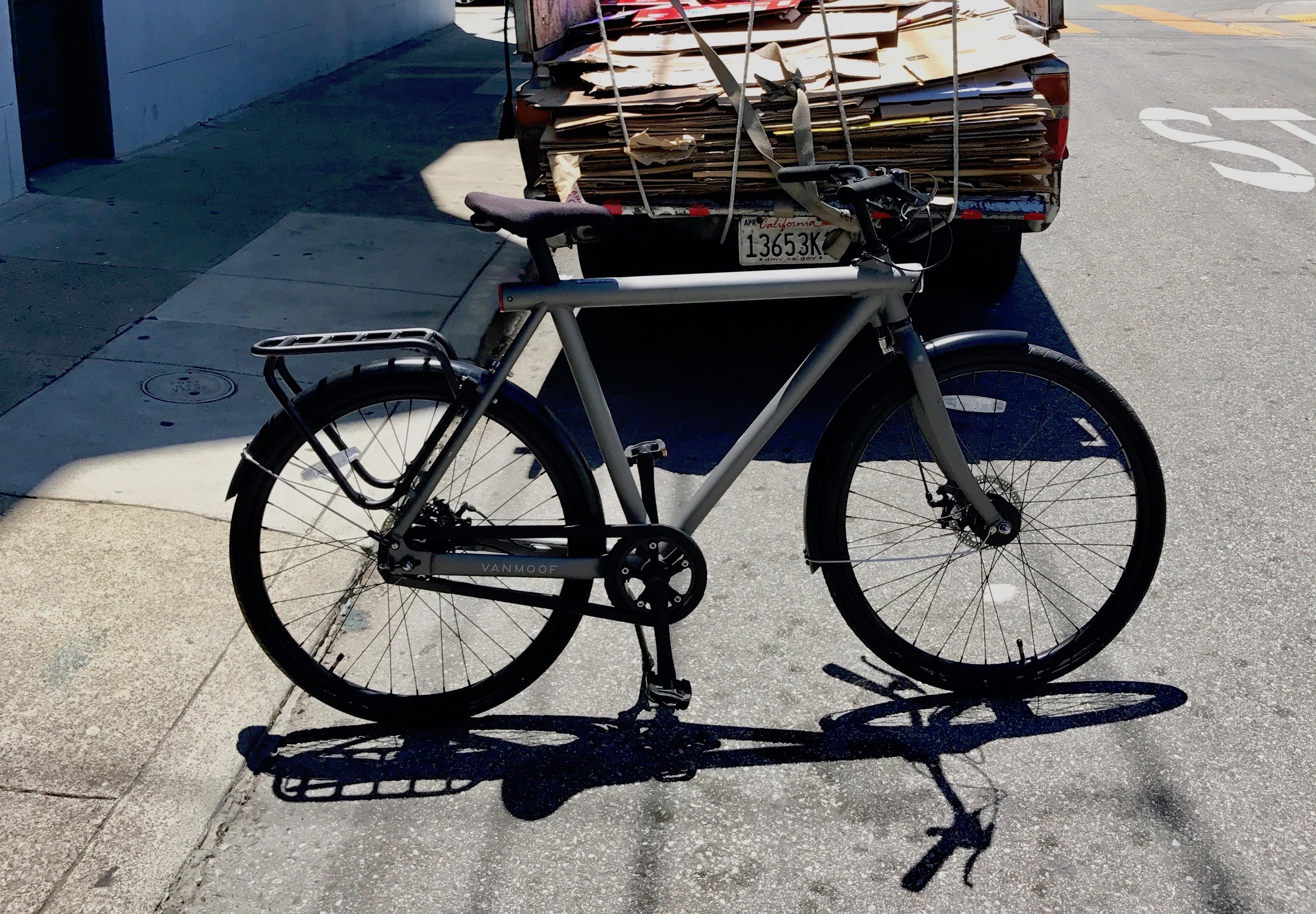
Tonight I am biking home from the video store, where I wheeled my Haro in and stuck Appleseed in the DVD return and wheeled out again, gliding down the sidewalk in the nine pm dark. Black hoodie no lights and a grin I crest one of the rises, happy to be back. They aren’t hills, I live out where it’s flat, where from the roof the sun sets on the Pacific, and where the wind from Asia shakes the trees. Tonight I am coasting down a sidewalk, silent, and the man walking out of the gym, shorts and sweat-wicking top, never sees me, his headphones in and head covered in sweat. I see him and dance past, my BMX nimble, its tires freshly inflated. Down the slope I go, past Roaring Mouse Cycles, who will swap out my brake cables on Tuesday next, something I’d thought about doing in Houston. But boxing and shipping and storing were in our future, this bike’s and mine, and those leave a lot of dirt on the chain, on everything, that needs cleaning and straightening.

Tonight we are done with that, this bicycle and me. Bought in Los Angeles while I was living in China I think it is glad, after our year’s sojourn in Houston, to be back in California, within reach of the Pacific. So am I, glad to be slipping down Iriving amidst the cars and fixies, late night diners and homeless men who accost me, “hey you on the bike!”

This little trip to the movie store is one of our first jaunts, just a quick spin up to 9th and Le Video, home to the greatest selection in the city, or so I was told. Our neighborhood seems to hold the kind of balance I have been seeking, it feels like, for years. Tonight though I am going for speed, for the thrill of no hands in the dark, and the strange acclimatizing that happens on returning to a BMX after a summer of riding full-size mountain bikes around Colorado.

Yesterday I watched the neighborhood while we wandered, the sounds of Hardly Strictly Bluegrass resounding over the trees.

“There’s a good balance here,” I said, “a few Vietnamese restaurants, a few Thai, a donut shop, all filled with people who speak Chinese.”

“I know,” she said, “it’s like being in Asia again.”

“But it’s got what I always wanted,” I said, my point coming together slowly.

“A donut shop?” She wasn’t far wrong.

“Yes, and a pizza place, and a bar that shows sports and serves tacos and is full of people I can talk to.”

“A mixture of Asia and the parts you like of New York,” she said, “in a neighborhood near the Pacific, and the park.”

“It’s small enough for me to know and foreign enough for me to feel alone,” I didn’t say, but have thought all day.

Tonight I know it’s all these things as I unlock the gate with my bicycle in one hand, and walk in to our courtyard quiet and warm. Half of the apartments are lit and the wind, which howls in from the ocean and down the streets, is held back by their walls. Chelsie the cat is no where in sight, but I know she’ll come visit when the afternoon sun pours in our windows. Her owner often wanders up, after an hour or two, to look for her through our open door. He’s content to have her wander the building, and we likewise, another part of the neighborhood not our own but familiar, and becoming home.

Lived in bars

May 1st, 2009

“They have a good Texas jukebox,” she tells me, of the oldest bar in Houston.  “And a table shaped like the state.”  The recommendation is enticing.  Sports are on TV, and a few old-timers at the bar when we wander in from the rain and out again soon after.

“It’s the cheapest place in town, which is sad,” I’m told, not immediately sure where the sadness lies, in the bar’s mid-level prices or the fact that spots far dingier, bars with no building, the beer in coolers behind the counter, the seats under the stars or smog, have done it no better on cost.  Indoors, a neon sign glows, bulbs along the edges blinking sporadically.  Cocktails, it says, the letters inside a giant curving arrow that points downwards and into a wall.  In the garden out back a five-foot cabbage patch kid is dwarfed by the Kool Aid Man, his body wider than I am tall.

“It’s the talk of the town, that’s for sure,” a friend admits, and asks what I think.  “It’s like the bars in LA I went to when I made money,” I offer.  She nods knowingly.  Well-designed, staffed by attractive people, a little industrial, big windows onto the street, not too much on the walls, no TVs.

“Let’s go somewhere we can watch the game,” we say, after driving to Austin in the afternoon.  At tall wooden tables we stand, the walls open to the air, pitchers half-full, watching a few games, depending on our angle, long into the evening.

I am fond of all of them, in some way, glad they exist, and happy to discover them as I re-discover America.  In Asia the very words are a concept, the “American bar”.  In Shanghai they have Filipino waitresses, if one is lucky, and Chinese bartenders, and their food is mediocre and expensive.  In Tokyo they are chains, with laminated menus and soda fountains, competing with TGIF rather than local izakayas.

There are jewels everywhere, of course, and we grow fond of them in cycles, with certain groups.  In Omiya for a while there was a bar with exposed metal rafters and a cat who wandered them, above our heads.  Eventually renovated it lost all character with the cat’s departure, and we followed the example.

Or the rocket ship, a concrete replica of a 1950′s Tom Swift craft, perched oddly atop an Omiya office building, home to a quiet space that held soft jazz and mid-90′s movie posters.  An excellent discovery, only ever occupied by the bartender and a friend of his, content to let us establish ourselves in a curve of the hull our last few months in the country.

“There’s a room inside the old vault,” a friend says of a bar that was once a bank.  I am there, one chilly evening a few days later, secure in many ways.  Amid the plush leather furniture it’s easy to forget the bar’s unfinished wood and sawdust feel, or the copious amounts of vomit in the only urinal.

“We’ve lived in bars and danced on tables,” she sings, her voice low and deep, not a thing of ambition but a fact of everywhere, played out in our lives and recommendations to new friends.

Quoted lyrics from Cat Power’s ‘Lived in Bars’ off of 2006′s The Greatest

Biking home after work

April 14th, 2009

Houston is a city built for the automobile.  Without zoning, urban centers are spawned and neglected, grow taller and are abandoned in ever-widening circles, and reclamation of the previously destitute takes far longer than in a city more constrained by geography, a New York, Boston, San Francisco.  In Houston there is no need, as long as the freeways run there is space, somewhere, out along their paths.  There is a certain snobbery, those ‘in the loop’ or out of it, but it is snobbery of the largely young towards the largely indifferent, and little comes of it.

Houston is a city of the oil industry, of NASA, and of doctors.  It is a city of the pickup truck and the SUV, where there seems to be no need to tell people to ‘buy American’ as they already have.  Chevy and GM’s woes would be invisible here save for the news, as their products outnumber their Japanese competitors in a fashion unfathomable to a boy from the north east.  This is a city where turn signals are optional, and cyclists given no quarter.

Yet there are cyclists, out among the cars, whispering by the dog walkers and joggers.  In some parts of town they are hip, the fixed-gear crowd, and passing them in whooshes on the way to Montrose’s cafes and restaurants, gear colorful and bags handmade, they could be in Greenpoint, on their way to Whisk & Ladle.  This is the part of Houston that east coast folk mention, along with the weather, when they note how they are pleasantly surprised with their lives in H-town.  These, though, are not Houston’s cyclists.

There are high schoolers with Haros and Mongooses, sitting on their pegs while spinning their handlebars idly at corners, chatting up girls in Catholic-school uniforms while pedaling backwards.  They would not be out of place in Los Angeles, though the girls would be dressed less formally, and the beach far closer.  Neither are these Houston’s cyclists, though they are of the city and, like the fixed-gear riders who push past them as they idle at stop lights, welcome in it.

Houston’s crowd slips through my neighborhood in the early evening hours, their jobs done, faces weathered, minds on their family or friends.  They work their way along the tree-lined blocks on bicycles well-used: old mountain bikes, a younger person’s BMX, a steel road bike.  They are in no hurry, postures relaxed and paths weaving.  I pass them smiling, always happy to see my neighborhood on two wheels.  They smile back, under their mustaches, knowing that we will pass each other again tomorrow.  They will be back far earlier than I will rise, though, at work at seven, cutting grass, trimming bushes, re-painting door frames and blowing leaves off expensive driveways.  They will sit behind my apartment and smoke at lunch, talking in Spanish of lives I grow more curious about each day.  This, then, is the Houston being built beneath and behind the SUV culture of those born to it.  It is a culture of those who cannot or do not own cars, and unlike New York, unlike Tokyo, they are not those who have chosen this method of transportation, but those who have been forced to two wheels.  With time, they too will purchase Ford F150′s, white and filled with lawn equipment, and pick up their friends, three to a cab carpooling to the rich neighborhoods of River Oaks, of West University.

Unlike the residents, with their helmets and lights, out for late night exercise, Houston’s other cyclists wheel through darkening neighborhoods as I do, almost impossible to see in the failing light, almost invisible socially.  Drifting through intersections ahead of BMWs and Mercedes they are a danger, and a surprise.  Yet they are also a portent of Houston’s future, as possible on two wheels as four, despite what this city was built for.

Summer ’99

March 26th, 2009

In my memory Ocean City is a pretty lonely place.  Even though I was living with a friend, sharing a house with four other people, and working with a dozen more, the sharpest parts of that summer are ones I spent alone.  This is true of anywhere, and why solo travel is more revealing than group tourism.  Ocean City wasn’t either of those, though.  It was a place to live for a summer that fit all of my requirements and fell into my lap.  A house, they claimed, for little enough, a few blocks from the beach and the lively boardwalk that meant jobs aplenty.  I can still feel the house, that amazing blend of wood and carpet, sand and dust that comes from being near the ocean and open to the weather.  Some houses, too often boarded up against storms or families returning to their northern homes, claimed a different odor, that of disuse and neglect, of age and mildew, with the ocean’s presence as an afterthought, something to be sought out beyond the walls.  Not ours.  On Sparrow Lane, a little two-block curve of road between Bayshore and Robin, both of which ran along the inlet, it was a place that seemed to have no windows or doors, the air constantly suggesting the weather outside.  We added to this with our plethora of fans, seemingly the only furniture college students in the north east ever really own.

Ocean City, on a map, resembles nothing so much as an accident, a mistakenly placed label over a long sliver of land separated from the coast of Maryland and Delaware.  For most of it’s length the city manages no more than four blocks of width, from bay to ocean.  Save for odd protuberances, small peninsulas on the bay-ward side like the one formed by Bayshore and Robin, which stretch west an incredible additional four blocks from Ocean Highway, which, running north to south is two blocks from the boardwalk and, usually, equidistant from the bay.  Like most accidents, Ocean City has the feel of a place clinging to its name, and to life, with the manic rush of a really good party.  It is a vacation town, an east coast boardwalk town, and a college one at that.  Our house, filled with five mostly-impoverished students on break and holding down whatever jobs available, was by no means unique.  The houses on either side were similar, and the trash in the big plastic blue can that sat by the telephone pole demonstrated a diet of Bud Lite and pizza delivery.  A lot of OC survived on late-night pizza, which was good, because two of my roommates made it, often coming home at one or two with a pie they’d prepped for our house while they closed down the kitchen.  I don’t know what it’s like now, that house, with it’s two-storey living room, the stairway winding up one side to a balcony, but if it’s just the same I wouldn’t be surprised, empty in the winter, housing another bunch of hopeful and hopeless students for the summer.

This college vacation town didn’t seem lonely.  With groups of people on each porch, with games of drunken whiffle ball in the street, it had the constant late-night ruckus of a town built on the service industry, where no one got off work until ten o’clock.  It was a place where a night out started when a friend who’s bouncing got on shift at a club, where activities on off-days consisted of going to visit the roommate that worked at the mini-golf range and playing a few rounds gratis.  No, on the surface, or when somebody’s folks came to visit, it didn’t seem lonely at all, always bustling with people, always somebody on their day off going to the beach.  But under that busy summer feel there was a sense of just how empty this place would be, in a few months, and just how little any of the people who had rolled up for the summer with their beach chairs and their shades on really cared.

I used to get up early, around five, to work the breakfast shift, a pretty good job, around fifty dollars for the morning if the place was busy.  Funny to say, since I’d walked into the house at the last minute, the final roommate and the last person to arrive, but I had the best job of the house, which wasn’t as good as it sounds.  I worked at a surf n’ turf place, right on the boardwalk.  Attached to a hotel, and with a pool bar, we only did breakfast and dinner, which was a great gig, and the hotel meant plenty of people, even when the weather sucked and no one wanted to wander the boardwalk before dinner.  When I woke my roommates would be sprawled out from the night, having come home at two with a pie and a sixer and gotten loud right around when I needed to get to bed, which didn’t bother me.  At nineteen going on twenty I’d gone sober for the summer, and was up and unlocking my bike from the porch before the sun.  Looking back those rides are a lot of why Ocean City seems so quiet, so lonely.  Sure someone might be passed out on the lawn next door, but more often the road was empty, the city asleep, and the sun just beginning to climb.  I’d bike down Robin to Bayshore, a couple of blocks, across the highway and out to the boardwalk.  The buildings, mostly one or two storey, were all shuttered, locked and graffitied, concrete shops that in the evening would have tables out slinging barbecue or ice cream, with flocks of people eating, chatting, and roaring off again down the highway.  Two blocks of old wooden beach-side residential, looking the way rental houses look after fifty years of weather and wear, and then two more of modern brick and concrete squares designed to sell something cheap to a whole bunch of people who’d never be back.  Without the crowds, as the sun broke over the horizon, it wasn’t an inviting sight.  I’d always remember my head waitress’s words then, crossing the empty four lanes of the highway on my mountain bike.  “In the winter,” she’d say, when we’d talk about how busy the boardwalk seemed, standing outside the restaurant just before opening in the evening, “you can walk the length of Ocean Highway and not see a single car.”  At five am it felt like I could do the same, as though the season had changed while I slept.

Then I’d get to the boardwalk, sharing it for ten blocks with the other bikers and joggers, mostly old folk up to see the sunrise on vacation.  I wondered if they knew about the ruckus that went on, a few blocks behind their ocean-view rooms, until just about dawn every night.  I wondered if they realized that the people living on food taken from the shop in which they worked, who washed with towels they stole from their hotel jobs, were just a block or two behind them, passed out on the lawn, having spent their marginal wages on the cheapest beer they could find within walking distance.  And then I’d glide down the boardwalk, riding with no hands, and I’d watch the sunrise over the Atlantic, which, for all the Pacific says they’ve got, is a beautiful sight worth waking up for.  The sun came up on that city like a curtain of orange and then pink and then yellow and then white, pulled up over this pale light blue wash that covered the sky.  Everyone on the boardwalk, all hundred of us or so, spread out over the fifty blocks, would turn and watch, just stand real still in our own little worlds of amazement.  And when it got to a certain height we’d all turn back to our jog or our hotel room, and I’d pull that swinging screen door open and head into the darkened kitchen.

Where Am I?

You are currently browsing entries tagged with Places at inhab.it.