July 31st, 2011
The mood of a place is dependent on small things, and weather. In San Francisco every single part of the city is informed by fog, by the lack of it or the lack of visibility it brings. Sunshine is a thing of sparse moments and joy, and the changes to workdays and clothing that come with the East Coast’s hundred degree days are hard to imagine, let alone replicate. We move in wide circles, but as I have said before, our bodies have short memories.
San Francisco smells of fruit and tall trees, of wind and buildings built primarily of wood. It smells of the dust from China that blows off the Pacific. Over everything, in the early afternoons of the season that the rest of the country calls summer, it smells like a city, a place where humans have struggled in close proximity for a hundred years.
And then the fog comes in, and the peninsula smells like an island in the ocean, the air filled with water and sand. On Irving, a man walking to dinner in July of two thousand eleven might wear a wool hoodie and jeans. In Brooklyn the same amble to dinner would entail shorts and flip-flops, sunglasses and a t-shirt.
Along Irving the street lights go on at six, their routine unchanged by the lengthening of day, for the fog darkens everything.
Thus in July we flee to the east, and drive windows down across Staten Island. The Verrazano bridge toll has been raised to $13, and the traffic is thick with accidents. The rental car is our fortress, allowing safe passage from state to state, allowing us to grow accustomed to the humidity without carrying our luggage as we do so. The gift of red-eye travel is in these surprising mornings before our new locations awake.
In New Jersey we play frisbee in the back yard, barefoot in the humid air, and sit on the deck in the afternoons, grateful for the quiet hours. After a few days we drive up through Pennsylvania, along roads from my childhood, past the small towns of her grandparents’ history. The gentle hills are green and the air is thick with fresh cut hay, with flies, and with small towns. After the West Coast’s sprawling hours of land without cities, the transition from New Jersey to Pennsylvania to New York takes no planning and happens in a leisurely afternoon.
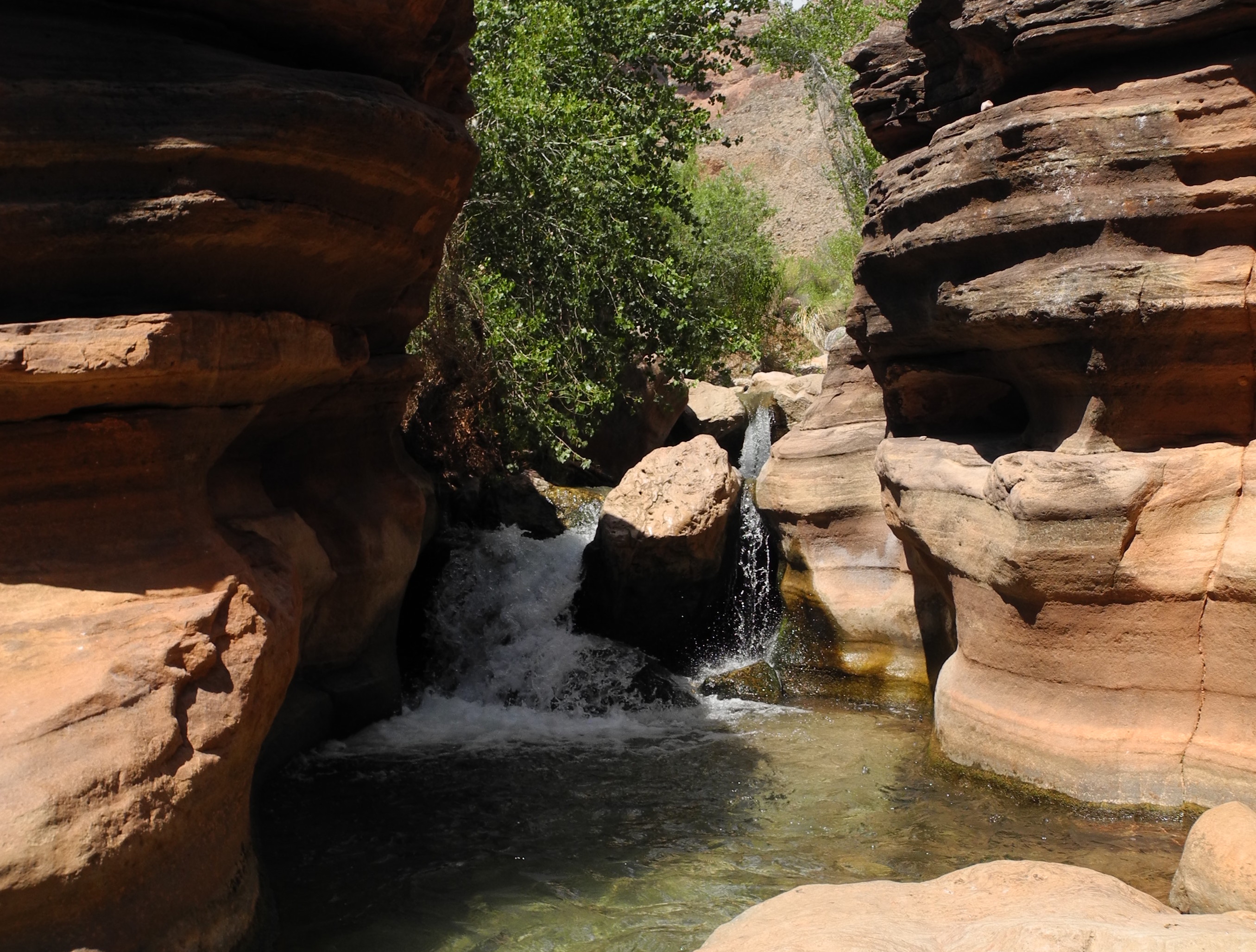
From the city, if not the house, of my birth, we adventure. We swim in gorges and wander to waterfalls. We sit by the side of the lake and watch the light fade, and set things alight and let them drift into the sky. Further from the ocean the air is less humid, and the long evenings a glorious reminder of what summer usually means. We do not think of San Francisco, or fog, choosing instead to watch lightning bugs in the trees of the back yard, their small flashes miraculous gifts of light.
In New York City later we sit on the concrete of Williamsburg and eat hand-crafted donuts in the shade, Manhattan across the water looking gorgeous in the sunshine. In the evening we crowd into the one room with an air conditioner, this strange piece of equipment everyone in New York has purchased as they grew able in the last decade of employment. In San Francisco no house has these boxes in the windows. Instead we shut the glass against the fog in the evenings and fling it open in the morning to let the wind in.
The evenings in Brooklyn move from park to rooftop to sofa, from large exuberant celebrations of summer to small conversations about the practicalities of shared spaces, and the hours fly quickly. In another two dozen we are back on our coast, back in the weather that is not a season, and back to the courtyard that houses a cat. The vacation has ended, and the memory will fade from our skin, but we have seen New York, and summer, again.
June 22nd, 2011
Directions are meaningless without a view of the ground. They serve as only the end points of a journey, and the transition from Texas to Nevada is difficult to note without the details of terrain, without any sense of the obstacles crossed. In the dark Las Vegas looks like a place half built by fantastic creatures with wild minds and half built by the most boring of beige square-desiring late 20th century Americans. Despite our individual wants we cannot escape the habits of comfort and communal conformity. In the seat behind me a woman composes a presentation. To my left another reads a self-help book, part of a poorly named genre.
To my right the window looks out on the Pacific, another journey entirely. The water feels fresh and beckoning, like the edge of the world I know it not to be. The opposite side has seats facing the valley, facing the mountains and deserts beyond that. Each time I am offered the choice on a small screen filled with chairs I choose the ocean, never the land.
I grow older on these flights, and learn about the bible.
An hour outside of Texas a woman gives me her explanatory book, heavily annotated. I cannot bear to throw away her efforts and in turn carry it for weeks, looking for a home for this most worn of thin-paged texts. Twice I offer it up to others who take it in jest and then peruse in earnest, once even borrowing it for a week, but eventually it is returned.
We travel in circles, unable to see.
I awake one morning in JFK with my best friend, and we have coffee without hurry at a place near the gate. He is sure this is the best the terminal has to offer, I am confused by the brief blast of humidity between jet and jetway and gate. A week later he will come home from work to find me reading on his sofa, us both within reach of the Pacific. In between he will see Vegas and I will see…
I stand on a mesa outside of a Mexican town famous only for its affordable beer. There is no sign of habitation save the road that stretches off in front of me, first down the hill and then out into the valley. In the distance other plateaus rise likewise from the rock, without vegetation or inhabitants. Across this vast expanse of land the weather varies but with enough visibility nothing it will bring can surprise.
Behind me stands a great mass of concrete and steel designed to keep men from their families, and from doing whatever they please. Ahead of me some few miles runs a strange fence, its individual panes the shade of rusted iron. It sways in the wind slightly, or seems to from a distance. From this side I do not approach it, tales of American vigilante posses too possible to tease me.
I do not quite grasp the language, but the motions for removing one’s belt and wallet seem to be a universal constant, and I leave the car with only my ID. It is worn and will be replaced in 2012 with one that bears a more passing likeness to me.
“Where is that boy?” one of my companions says, when presented with that smiling picture.
“It’s from a photo booth under the Saikyo line in Japan,” I say, as though that explains everything.
We walk in through scanners and detectors, with declarations and pat downs, to do the things we woke early in another country to do. And on the way out we stand quiet in the startling brightness, the sun in full reflection off the concrete and sand, and cover our eyes with our hands.
We do not speak about it, but we are trying to remember this landscape forever.
April 24th, 2011
“I live up in the back,” he says, gesturing with the lit end of his cigarette towards the red awning of Northern Tiger Kenpo. Inside, through the plate windows that are remnants of the space’s commercial origin, a dozen ten year olds pivot and punch the air in unison. Their shouts are muffled from outside, and in the afternoon light we watch their practice for a while. Clad all in white, with their belts of differing colors, they are led by a man in his forties, with the kind of solid physique, the sense of density, so suited to a martial arts instructor.
“I take care of the place, look out for it, and he lets me stay there.” His explanation comes with the self-deprecation of one who is not sure how they came to be where they are. “We’ve been friends for years, he’s helping me out.” The last matter-of-factly, un-embroidered. “It’s pretty quiet,” he tells me, cigarette almost finished. “Except when they’re training…”
“Right,” I say, as he rubs the butt out with his shoe, and picks it up again. When they’re training, from three pm to eleven or so, he is often outside, calmly watching the sidewalk here a few steps from Irving. We look to the corner, past the shoe repair and Chinese medicine place, to the corner stores and the frozen yogurt shops beyond. A young couple strolls, arm in arm, across 19th, heading east. They don’t look right to see us, one holding a cigarette butt, now crushed, and one holding two bags of groceries from 22nd Street Grocery, the Greek-owned store that sells many kinds of olives, cheese and fresh vegetables, but no meat. It is my favorite grocery store.
“It’s a good neighborhood,” I say, trying to offer something up to the silence between us, a quiet penetrated only by the vague shouts of the practice in Northern Tiger and the slap of the Chinese men up the street putting down pieces in their never-ending Xiangqi game. He nods, following my gaze up to the folding metal table set up near the curb and the three men who surround it, one in plastic sandals and leather jacket, one in suspenders, all focused most furiously on the game. They speak Cantonese, I’ve discovered, and seem to play at least six hours a day, out on the sidewalk if the weather’s willing and in the open garage if the Sunset is threatening rain.
This is our block, me and my quiet apartment building where Chelsie the cat patrols the courtyard, Northern Tiger where classes of young girls, young boys, and older men learn how to defend themselves, and the game of Chinese Chess. The man standing before me, his hair slowly gowing gray, is a part of this block, a silent watching witness, someone who nods hello and recognizes everyone. I don’t know where he’s come from, prior to the strange loft at the back of Northern Tiger, it’s contents hidden by a sheet strung up as a curtain, separating it from the worn wooden floor of the training area.
A year and a half later I wonder one day if he’s moved on. Working far to the north I no longer spend afternoons wandering slowly up and down Irving, doing groceries or laundry, buying household supplies or wine. The game of Xiangqi continues I know, it’s members still outside on warm Saturdays, seemingly unchanged by the last year. The smoking man of Tiger Kenpo though may have moved on, his arrangement always felt short term, just for a while, in his own words. Where is he now, and what does he do, what did he do before moving into the dojo by himself?
And then one evening I am walking down Irving in the warmth of an April night and I see him, almost invisible in the dark. The door to Tiger Kenpo is propped open with a wooden wedge, and the interior dark. Were it not for this man, smoking without sound beside the parked cars of 19th, it would seem abandoned. As I turn the corner, on the far side of the street, he finishes and ducks back in, latching the glass and metal door behind him and disappearing into the dark.
Where did he come from, I wonder again, and what has he done this past year, while I’ve been away most days? What does he think about his life now, lonely after the students have come and gone, after the master has taught and then packed up, changed and gotten back in his car to return home. When they have all left and the place no longer rings with rythmic shouting, when he sweeps and turns off the lights and steps outside into the night to smoke, what does he think about this block, this city?
These questions fill me, heading home again with arms laden with dinner, and I peer inside as I pass by. There is nothing to see, no lights on even up in the loft at the back. When we first met I wondered if he trained at the dojo, and how he’d met the owner. Mostly, tonight, I am happy to see him, still a part of this neighborhood, and I hope he would agree.
April 10th, 2011
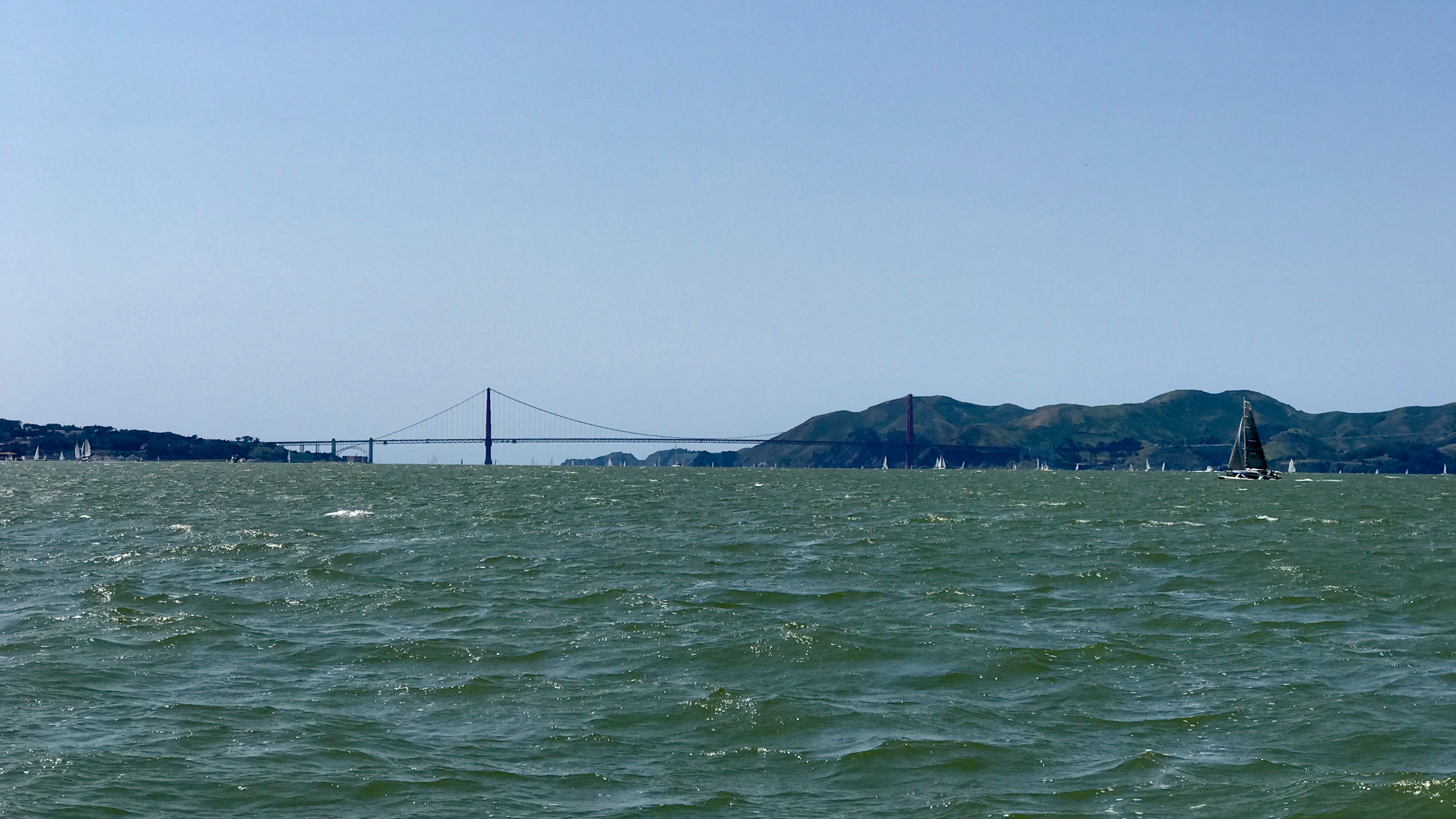
In the first long afternoons of light the city looks strangely wide. Swinging down from the hills of Marin towards the Golden Gate it stretches out before him across the horizon from the bay to the ocean. The peninsula is painted white and green and white and green again, the overlapping colors of buildings and hills, trees and houses that remind him of the importance of topography in any representation of San Francisco. There are strange tall points, the TransAmerica building, the Hong Kong-esque apartment towers of Russian Hill, with their tiered balconies, and the oddly-large churches of Pacific Heights, of the Richmond. Coight Tower is small and almost invisible in the light, off to the left. Behind it, reaching out towards the islands and the cranes of Oakland, the Bay Bridge forms an edge to the view of this city framed by suspension towers.
San Francisco, in the right light, is capable of surprise. He is reading fiction again at pace, working through stories of this city first read long ago without the aid of geography. Revisiting his mental San Francisco now with new layers of personal history, the same way he’d obsessed over Shanghai, Tokyo, he discovers buildings and locations. To take a city out of literature and into one’s own history is a delicate act. Often the fragile place of words and imagination is lost forever, mental ties not strong enough to withstand the daily monotony of work and rent and grocery shopping. Sometimes though, on afternoons like this one, the city provides its own majesty, reminding the newly arrived that yes, here is the place of stories, a landscape of the human so varied and involved as to conjure history.
Re-reading these books about this city he is caught up in their description of bridges, of people, and of light. On the bridge now he looks towards the ocean, where the sun is setting into the fog. A freighter works its way towards him, bearing goods from Japan, heading for the port of Oakland across the bay. By the time it docks the light will have faded and the fog moved in on his home, hidden from view on the bridge by the green hills of Golden Gate Park. By the time the light fades he will have crossed the other bridge as well, exploring the train tracks across the bay, where grass fields are lit behind warehouses and beneath freeways that reach towards Cheyenne, Cleveland, New York.
March 29th, 2011
In the steaming fog of the dumpling shop the rain outside doesn’t seem so out of place. On Irving this afternoon the sun was hidden by clouds long before it set, late now the day after the equinox. The streets have been filled with shoppers, students, families these past few days, since the sun no longer sets at five. Daylight Saving Time may be an oddity, a trick we play on ourselves with math and clocks, but it works. We are a happier people when we see the sun.
Tonight the wind came in early, fog and rain along side. No one complains, knowing deep down winter is over. Even in California the spring brings relief, and it’s tempestuous showers cause no ill will.
“This is dumpling weather,” she says. I concur. This is weather for fogged-up windows and large numbers crammed in small rooms. We take novels and drink tea, ordering in fragmented Mandarin and cherishing the hot sauce. On the way home we watch the rain, lighter now, patter on the pavement, reflecting the headlights of 19th Ave.
“This weather’s good for the Little Shamrock too,” I say, continuing our conversation about things just perfect for this weather. The self-proclaimed oldest bar in town, the Shamrock is a cozy kind of place with a fire and padded chairs, built for rainy Sundays.
“They wouldn’t do well in a sunnier neighborhood,” she says. “Too dingy.”
We cross, watching the fog sneak across the street on Irving, now fully at ground level. It is our second year here, in this weather of swirling shapes and constant drizzle that we so enjoy in part because we know where to go when the world becomes a place of damp and chill. Having learned the neighborhood grown out of the fog, we are no longer put down by it’s weight.
In Houston there were no dumpling houses like the King of Noodle, no bars like the Little Shamrock. Instead Poison Girl featured bike racks outside and a garden that was heavenly in February, perfect in November. Filled with plants and vines that snaked up and over the walls into neighboring yards, this space felt felt utterly unlike the dive bar it belonged to, and yet perfectly attached. Like the Shamrock, Poison Girl was built of it’s neighborhood, of it’s weather.
Weather is the strongest of forces, a statement that needs no proof save the news, and it shapes the places of people far more than we pretend. At Beach Bum on Boracay the drinks are built for long afternoons spent barefoot on the sand, and when storms blow they build walls of sand against the rising tide. It is an establishment made possible by the location, and then refined by weather.
To know a city, a town, a beach, then, we must embrace the weather there, be it by hiding near the fire or lolling barefoot. In San Francisco that idea has taken us most of two years to learn, here where the ocean joins the air and rolls over the land, where the fog is a member of the neighborhood, and where the best bars are cozy, the best restaurants steamy.