Coming home

September 18th, 2009

Those words, for anyone long removed from the later, are some of the strongest.  They bring instant emotion even on a smaller scale, the words of a father on the phone at the end of the workday.  Yet they can be tainted with nervousness at longer exposures, with an underlying uncertainty of what will have changed, and whether home as we remember it still exists.

These words have a new meaning to me, these past few days.  For the first time in several months they again represent a space of my own, of our own.  We no longer rely on the incredible generosity of our friends and families, whose spare rooms and couches,  pull-out mattresses, aerobeds, and attics have sheltered us so well this summer.  The door to this apartment is opened by keys only we possess, and the bathroom will be cleaned by no one else.  There are drawbacks, the shower head slightly too low, the cabinets that do not close on their own, but they are our problems, and I relish the walk to the hardware store that will fix them.

Having mentioned already the secrets each new house presents, the opportunities to re-establish old patterns and form new habits I will only say that, in their absence, I had much missed my house keys and a place to put them.

Circus of cats

May 31st, 2009

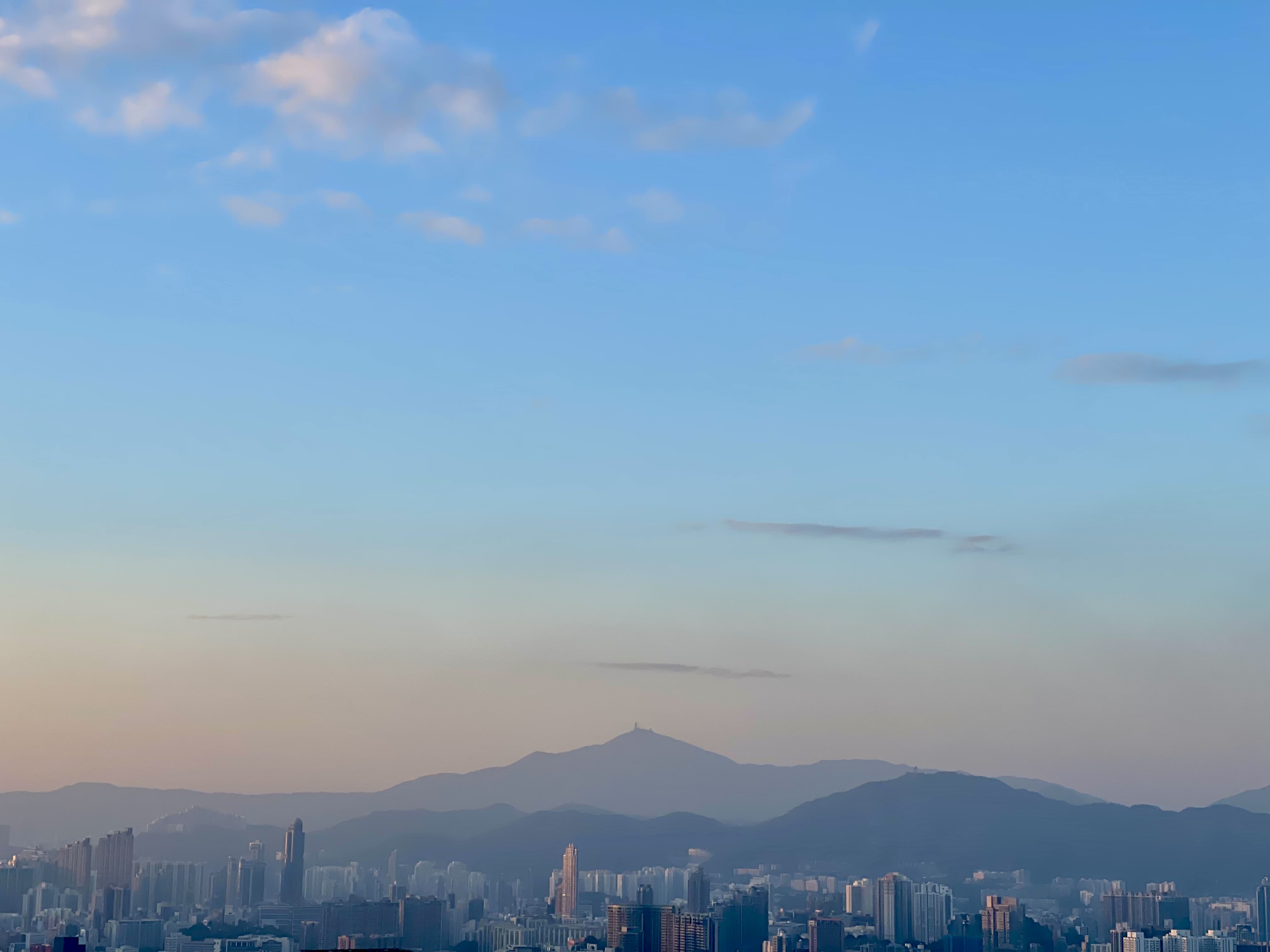
A year ago I sat on a rooftop in Hong Kong and watched the cats roam Sheung Wan’s streets from far above as the day’s heat soaked back out of the concrete towers and into the sky.  In Houston this last month I have watched them again, how they prowl and play once evening approaches, content out of doors once the sun has fled.  In this complex of houses become apartments there are many, of all colors and temperaments.  With time, patience and an interest in their doings, we become familiar with each other.

Winnie, longer-haired orange and sleek, a rescue from Galveston who spent ten days on a rooftop post Ike, is the new king.  The tufts of fur behind his ears attract attention, and he spends the evenings on his brick doorstep, content to watch others antics in the fading heat.

Magic, skinny young and short-haired black, chases a bullfrog into the shrubs, wild-eyed and bounding.  Winnie waits a moment and then ambles after, as though curious to see what Magic would do with this strange-sounding beast.  Unimpressed he slinks back to his stoop, and ten minutes later Magic is sitting on the wooden bench licking his paws, the bullfrog forgotten.

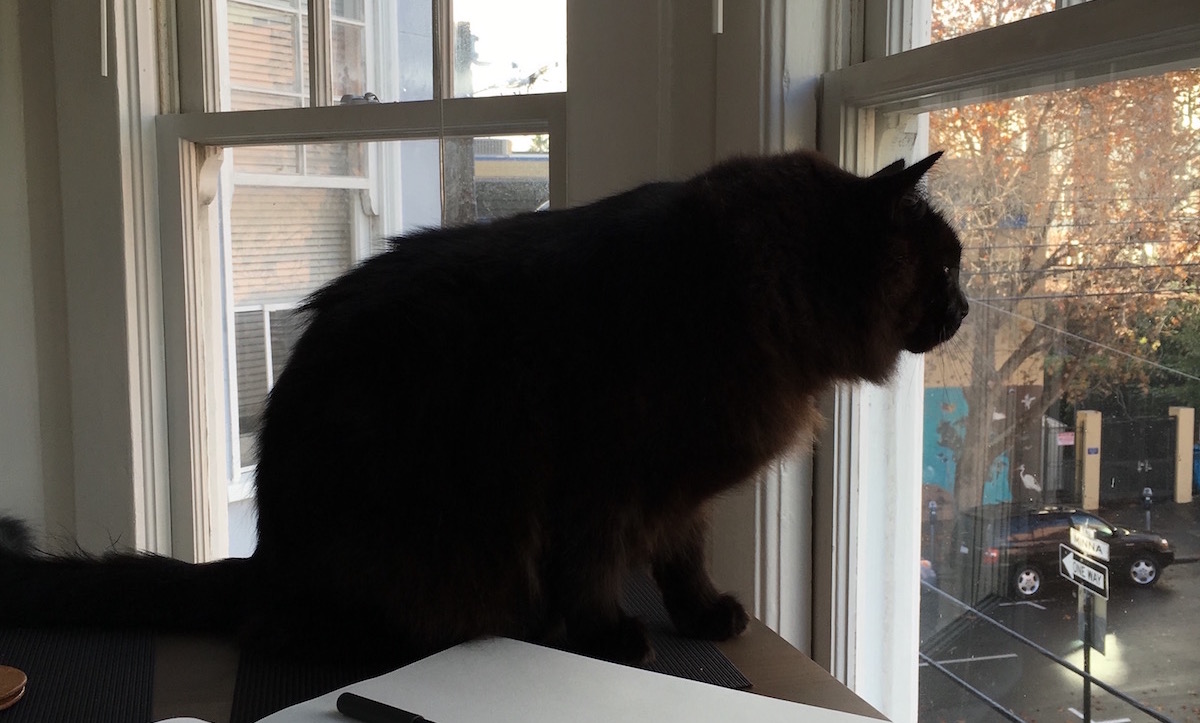
“How long do their memories last,” a friend wonders, sitting outside around the patio furniture watching a large orange and white cat flirt with Winnie, lured by his low profile and huge ear tufts.  “Do they remember each other or just vague impressions, people or just where they are fed?”  None of us know the answer, and in the perfect warmth of ten pm no one moves to discover it.  Instead we speculate on their behavior, watching Boo Boo, an indoors-only Siamese mix with light blue eyes who has come to the window, his fur pressing through the screen as he watches Winnie and these people.

Milo is the old man of the neighborhood, in time here if not in years.  His family has cut a cat door into the building entrance, dignifying his comings and goings beyond meowing for a helping hand.  Yet he is uneasy as the population swells, Winnie’s arrival followed by another smaller orange and white, and then a black and white hunter, a grey tiger indoor cat, and more.  Milo eyes them from a tree across the street that only he seems able to climb, and, finding him there one evening I think he remembers a less-crowded block, where he could prowl behind shrubs by his lonesome.

How long is a cat’s memory, we asked, and I, packing this apartment with it’s squirrel highway and it’s windows, it’s odd hiding places, wonder how long is the memory of a place?  Will Winnie remember us when we leave?  Milo?  This apartment?  How long until no one remembers us, standing still in the fading light, seeking out the hunters where they stalk behind the bushes.

The black and white, name unknown, chases a lizard as we pack the car, dropping it’s squirming body from mouth to pavement only to bound upon it again as it races away across the pavement.  It is a favorite activity, the lizards numerous and slow in the morning heat, before all things retreat near noon.  They do not remember, I think, these small creatures that flee vertically, climbing the brick out of the reach of Milo’s claws.  This apartment has no memory, save that of holes and scrapes, of hangars left in closets and marks where the dresser touched the wall.  Like the lizards it will be standing here tomorrow, no outward sign of vacancy.

How long do even we remember, though, haughty in our questioning of cats?  Hong Kong, a year ago, has already begun to fade, and this apartment too will be shrunk down, condensed to a smattering of images, like those cats seen from rooftops and visits from old friends.  We move on, inhabiting one place after another, confident in our memories, though less durable than these walls and their scars.  Maybe Magic will wonder where we’ve gone, lying mid-driveway in the morning light where we used both to watch the mail arrive.

For a little while so will I.

Lived in bars

May 1st, 2009

“They have a good Texas jukebox,” she tells me, of the oldest bar in Houston.  “And a table shaped like the state.”  The recommendation is enticing.  Sports are on TV, and a few old-timers at the bar when we wander in from the rain and out again soon after.

“It’s the cheapest place in town, which is sad,” I’m told, not immediately sure where the sadness lies, in the bar’s mid-level prices or the fact that spots far dingier, bars with no building, the beer in coolers behind the counter, the seats under the stars or smog, have done it no better on cost.  Indoors, a neon sign glows, bulbs along the edges blinking sporadically.  Cocktails, it says, the letters inside a giant curving arrow that points downwards and into a wall.  In the garden out back a five-foot cabbage patch kid is dwarfed by the Kool Aid Man, his body wider than I am tall.

“It’s the talk of the town, that’s for sure,” a friend admits, and asks what I think.  “It’s like the bars in LA I went to when I made money,” I offer.  She nods knowingly.  Well-designed, staffed by attractive people, a little industrial, big windows onto the street, not too much on the walls, no TVs.

“Let’s go somewhere we can watch the game,” we say, after driving to Austin in the afternoon.  At tall wooden tables we stand, the walls open to the air, pitchers half-full, watching a few games, depending on our angle, long into the evening.

I am fond of all of them, in some way, glad they exist, and happy to discover them as I re-discover America.  In Asia the very words are a concept, the “American bar”.  In Shanghai they have Filipino waitresses, if one is lucky, and Chinese bartenders, and their food is mediocre and expensive.  In Tokyo they are chains, with laminated menus and soda fountains, competing with TGIF rather than local izakayas.

There are jewels everywhere, of course, and we grow fond of them in cycles, with certain groups.  In Omiya for a while there was a bar with exposed metal rafters and a cat who wandered them, above our heads.  Eventually renovated it lost all character with the cat’s departure, and we followed the example.

Or the rocket ship, a concrete replica of a 1950′s Tom Swift craft, perched oddly atop an Omiya office building, home to a quiet space that held soft jazz and mid-90′s movie posters.  An excellent discovery, only ever occupied by the bartender and a friend of his, content to let us establish ourselves in a curve of the hull our last few months in the country.

“There’s a room inside the old vault,” a friend says of a bar that was once a bank.  I am there, one chilly evening a few days later, secure in many ways.  Amid the plush leather furniture it’s easy to forget the bar’s unfinished wood and sawdust feel, or the copious amounts of vomit in the only urinal.

“We’ve lived in bars and danced on tables,” she sings, her voice low and deep, not a thing of ambition but a fact of everywhere, played out in our lives and recommendations to new friends.

Quoted lyrics from Cat Power’s ‘Lived in Bars’ off of 2006′s The Greatest

Summer ’99

March 26th, 2009

In my memory Ocean City is a pretty lonely place.  Even though I was living with a friend, sharing a house with four other people, and working with a dozen more, the sharpest parts of that summer are ones I spent alone.  This is true of anywhere, and why solo travel is more revealing than group tourism.  Ocean City wasn’t either of those, though.  It was a place to live for a summer that fit all of my requirements and fell into my lap.  A house, they claimed, for little enough, a few blocks from the beach and the lively boardwalk that meant jobs aplenty.  I can still feel the house, that amazing blend of wood and carpet, sand and dust that comes from being near the ocean and open to the weather.  Some houses, too often boarded up against storms or families returning to their northern homes, claimed a different odor, that of disuse and neglect, of age and mildew, with the ocean’s presence as an afterthought, something to be sought out beyond the walls.  Not ours.  On Sparrow Lane, a little two-block curve of road between Bayshore and Robin, both of which ran along the inlet, it was a place that seemed to have no windows or doors, the air constantly suggesting the weather outside.  We added to this with our plethora of fans, seemingly the only furniture college students in the north east ever really own.

Ocean City, on a map, resembles nothing so much as an accident, a mistakenly placed label over a long sliver of land separated from the coast of Maryland and Delaware.  For most of it’s length the city manages no more than four blocks of width, from bay to ocean.  Save for odd protuberances, small peninsulas on the bay-ward side like the one formed by Bayshore and Robin, which stretch west an incredible additional four blocks from Ocean Highway, which, running north to south is two blocks from the boardwalk and, usually, equidistant from the bay.  Like most accidents, Ocean City has the feel of a place clinging to its name, and to life, with the manic rush of a really good party.  It is a vacation town, an east coast boardwalk town, and a college one at that.  Our house, filled with five mostly-impoverished students on break and holding down whatever jobs available, was by no means unique.  The houses on either side were similar, and the trash in the big plastic blue can that sat by the telephone pole demonstrated a diet of Bud Lite and pizza delivery.  A lot of OC survived on late-night pizza, which was good, because two of my roommates made it, often coming home at one or two with a pie they’d prepped for our house while they closed down the kitchen.  I don’t know what it’s like now, that house, with it’s two-storey living room, the stairway winding up one side to a balcony, but if it’s just the same I wouldn’t be surprised, empty in the winter, housing another bunch of hopeful and hopeless students for the summer.

This college vacation town didn’t seem lonely.  With groups of people on each porch, with games of drunken whiffle ball in the street, it had the constant late-night ruckus of a town built on the service industry, where no one got off work until ten o’clock.  It was a place where a night out started when a friend who’s bouncing got on shift at a club, where activities on off-days consisted of going to visit the roommate that worked at the mini-golf range and playing a few rounds gratis.  No, on the surface, or when somebody’s folks came to visit, it didn’t seem lonely at all, always bustling with people, always somebody on their day off going to the beach.  But under that busy summer feel there was a sense of just how empty this place would be, in a few months, and just how little any of the people who had rolled up for the summer with their beach chairs and their shades on really cared.

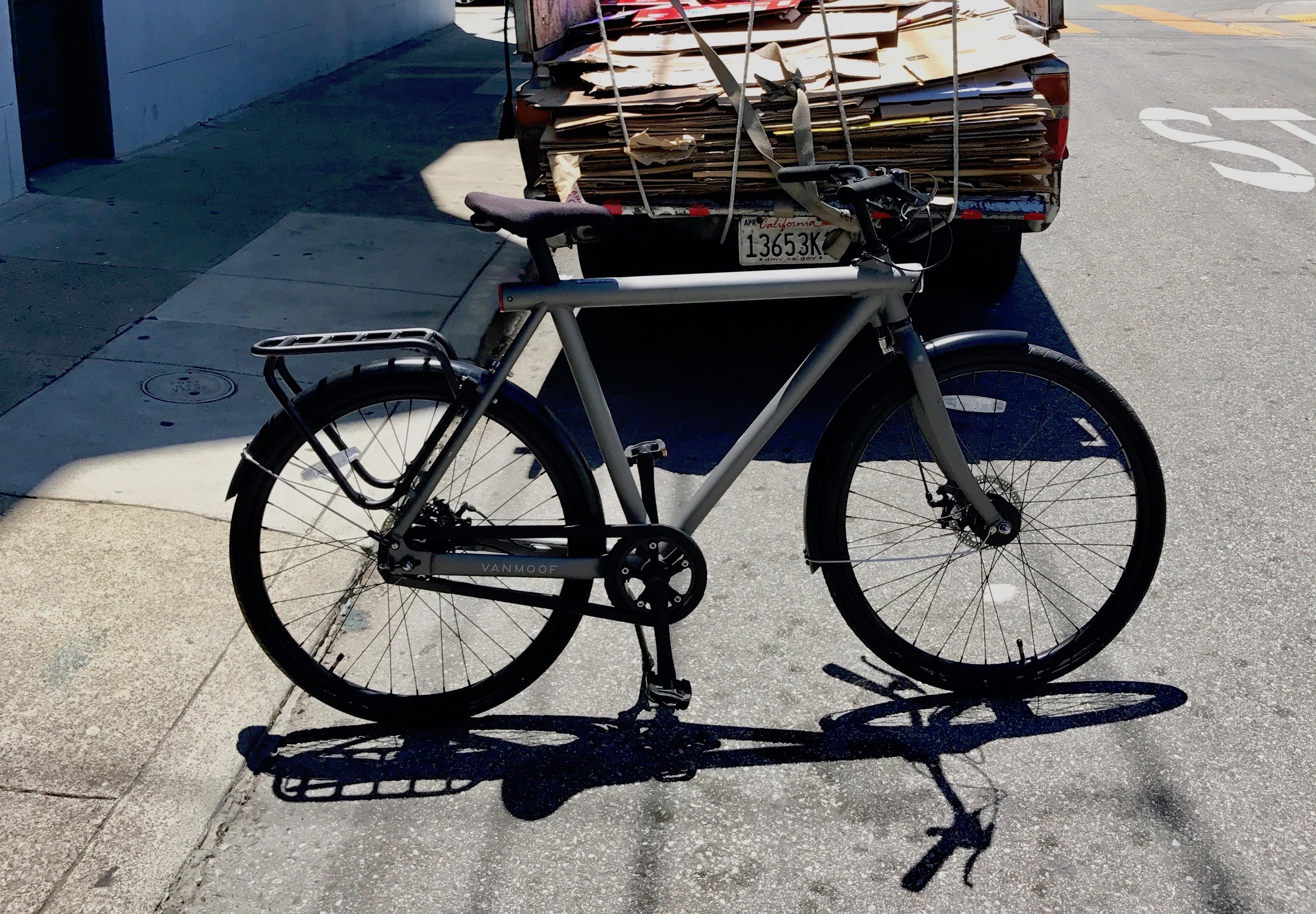
I used to get up early, around five, to work the breakfast shift, a pretty good job, around fifty dollars for the morning if the place was busy.  Funny to say, since I’d walked into the house at the last minute, the final roommate and the last person to arrive, but I had the best job of the house, which wasn’t as good as it sounds.  I worked at a surf n’ turf place, right on the boardwalk.  Attached to a hotel, and with a pool bar, we only did breakfast and dinner, which was a great gig, and the hotel meant plenty of people, even when the weather sucked and no one wanted to wander the boardwalk before dinner.  When I woke my roommates would be sprawled out from the night, having come home at two with a pie and a sixer and gotten loud right around when I needed to get to bed, which didn’t bother me.  At nineteen going on twenty I’d gone sober for the summer, and was up and unlocking my bike from the porch before the sun.  Looking back those rides are a lot of why Ocean City seems so quiet, so lonely.  Sure someone might be passed out on the lawn next door, but more often the road was empty, the city asleep, and the sun just beginning to climb.  I’d bike down Robin to Bayshore, a couple of blocks, across the highway and out to the boardwalk.  The buildings, mostly one or two storey, were all shuttered, locked and graffitied, concrete shops that in the evening would have tables out slinging barbecue or ice cream, with flocks of people eating, chatting, and roaring off again down the highway.  Two blocks of old wooden beach-side residential, looking the way rental houses look after fifty years of weather and wear, and then two more of modern brick and concrete squares designed to sell something cheap to a whole bunch of people who’d never be back.  Without the crowds, as the sun broke over the horizon, it wasn’t an inviting sight.  I’d always remember my head waitress’s words then, crossing the empty four lanes of the highway on my mountain bike.  “In the winter,” she’d say, when we’d talk about how busy the boardwalk seemed, standing outside the restaurant just before opening in the evening, “you can walk the length of Ocean Highway and not see a single car.”  At five am it felt like I could do the same, as though the season had changed while I slept.

Then I’d get to the boardwalk, sharing it for ten blocks with the other bikers and joggers, mostly old folk up to see the sunrise on vacation.  I wondered if they knew about the ruckus that went on, a few blocks behind their ocean-view rooms, until just about dawn every night.  I wondered if they realized that the people living on food taken from the shop in which they worked, who washed with towels they stole from their hotel jobs, were just a block or two behind them, passed out on the lawn, having spent their marginal wages on the cheapest beer they could find within walking distance.  And then I’d glide down the boardwalk, riding with no hands, and I’d watch the sunrise over the Atlantic, which, for all the Pacific says they’ve got, is a beautiful sight worth waking up for.  The sun came up on that city like a curtain of orange and then pink and then yellow and then white, pulled up over this pale light blue wash that covered the sky.  Everyone on the boardwalk, all hundred of us or so, spread out over the fifty blocks, would turn and watch, just stand real still in our own little worlds of amazement.  And when it got to a certain height we’d all turn back to our jog or our hotel room, and I’d pull that swinging screen door open and head into the darkened kitchen.

Personal geographic

May 27th, 2008

Memories lie dormant all over this city. In Fuxing park, after years away, they return suddenly. A February afternoon, jacket collar up against the wind, slips over me despite the heat of May. A face I haven’t pictured in years comes back instantly, bringing with it hand-holding and small pleasantries I had thought ashes of personal history.

They fade, says a rumor of memories, are dulled by repetition and become faint traces barely accessible with conscious effort. This is true, in some way, as oft-recalled scenes are now at least part composition, part invention, rather than their original fact. Graduation day’s weather, easily confirmable through photographs and weather sites, is reassuringly mapped onto memories of that day. I do not believe I have any real ability to visualize the clouds, if clouds there were, puffy and scattered. Perhaps seeing the hill, the view of the lake through the trees would suddenly snap the sky into focus in my mind. Perhaps not, and that amphitheater would instead provoke other days, as the layers of personal history are deep there, the days set upon one another like palimpsests.

A small town, I think, can not hold as many of these ambushes, each place too frequently visited to retain a single moment for long enough to shock. With this thought comes the image of a bridge, and a long-dead friend perched upon it’s girders, slung below the road surface yet high above the gorge, a place I haven’t visited in a decade.  No, these mental ties to geography do not require size, not always.

Barefoot and throwing a frisbee in the late afternoon sun amid a flock of kites the shape of eagles, the memories are of another evening, drinks outdoors in the garden visible beyond a hedge. The friends of that evening are not dead, thankfully, just far away, long since relocated to London, to Australia Boston New York Maine Hawaii Hong Kong, and only three people. Years gone now, the routine of days passing around this park, but never through, the memories unmentioned, untouched with their participants scattered.

Yet the size of a place does enable this forgetting, allowing frequented pathways to be forgotten by a change of job, a move several blocks north. A dumpling shop on Jianguo Lu closes for May holiday, three days, purchasing chairs and new tables in the interim. A crazy night there comes back to me, from years before at three am. Another expat in a three-piece suit, too drunk to see, ranting about something and his face familiar all the while. The winter of ’03, perhaps. The day is not clear, the need for dumplings at such an hour even less so. Only that face, and the suit, and the hour return upon re-entering this tiny restaurant.

Where Am I?

You are currently browsing the Habits category at inhab.it.